Why Interior Designers Should Be Hired Before Your Architect Draws a Single Line

Updated: Oct 4
The conventional wisdom about building a custom home has a sequence baked into it: hire an architect, develop the plans, begin construction, then bring in an interior designer to handle the finishes and furnishings once the structure exists. It's a logical-sounding order. It's also one of the most reliably expensive mistakes a homeowner can make — not because architects aren't excellent at what they do, but because what they do and what an interior designer does are not consecutive tasks. They are parallel ones, and treating them as consecutive is what produces the homes that are architecturally impressive and quietly difficult to live in.
This is a conversation we have often with homeowners across Northern Virginia, Maryland, and Washington DC — in the early planning stages of new builds in Vienna and Great Falls, in the pre-renovation discussions for Bethesda colonials and Georgetown rowhouses, in the initial consultations for Potomac estates where the architectural ambition is significant and the margin for misalignment is equally so. The homeowners who push back most on the idea of hiring a designer first are almost always the ones who come back, a year into their project, wishing they had.

Two Disciplines, One Home
Architecture and interior design are related disciplines with genuinely different orientations. An architect thinks primarily about the building — its structure, its envelope, its relationship to the site, its compliance with code, and the integrity of its spatial volumes. These are not small things. They are the foundation on which everything else depends, and a skilled architect brings a level of technical and spatial intelligence to a project that is irreplaceable.
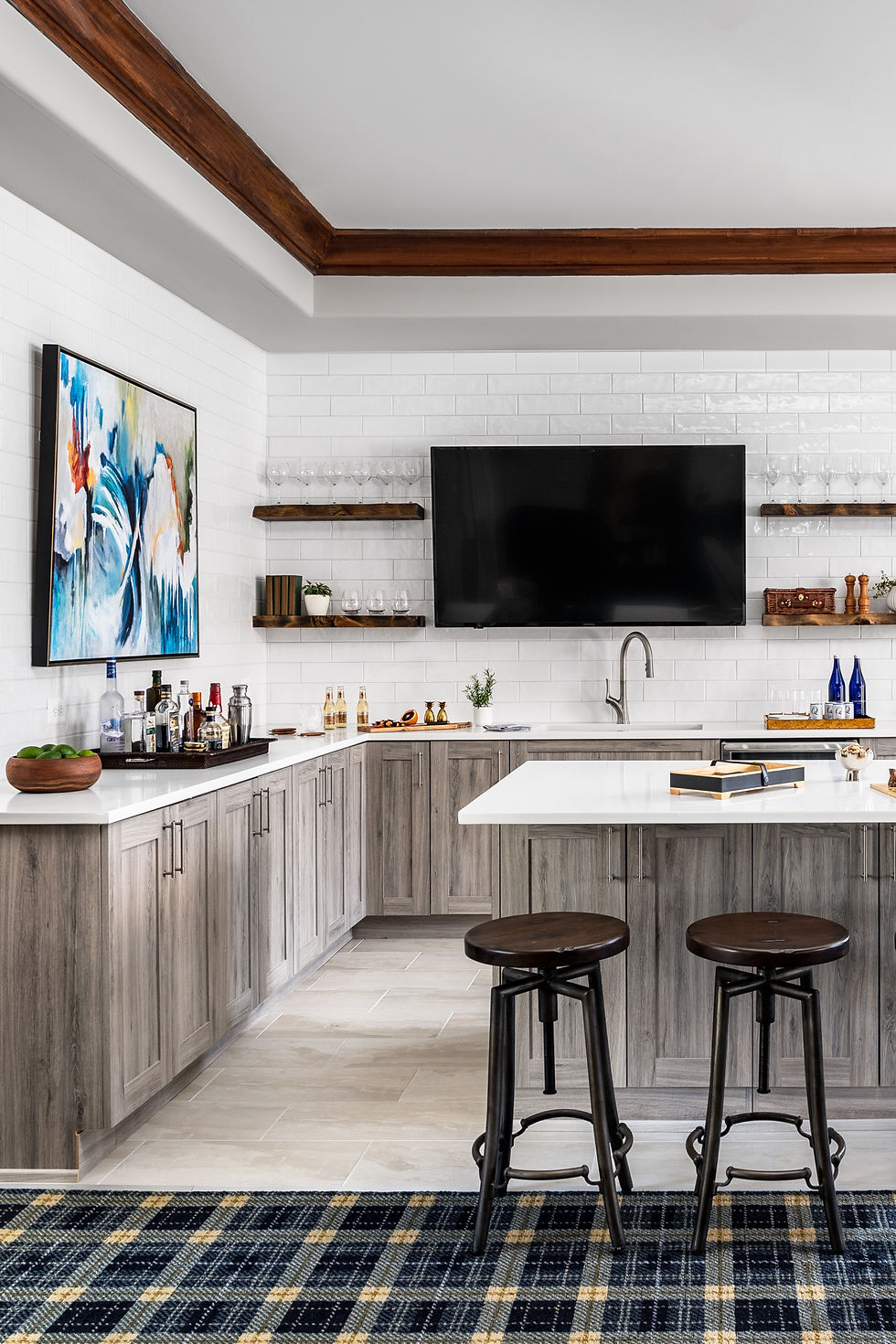
But an architect is not, by training or by instinct, thinking about where the sofa goes. They are not thinking about whether the primary bedroom's window placement will make a freestanding tub position feel considered or awkward. They are not thinking about the height at which art will hang in the entry foyer, and whether the ceiling detail they've specified will compete with or complement it. They are not thinking about whether the kitchen island's orientation creates the sightline from the living area that makes an open floor plan feel intentional rather than accidental. These are interior decisions — decisions about how a space will be inhabited — and they have profound architectural consequences that are almost impossible to address once the drawings are finalized.
When a designer is in the room while those drawings are being made, the conversation changes. Ceiling heights get questioned before they're set. Window placement gets evaluated against furniture layouts that don't yet exist but will. The relationship between rooms gets considered not just as a spatial diagram but as a lived sequence — the experience of moving from entry to living room to kitchen to dining room, and what that sequence asks of each transition. These are not decorating decisions. They are fundamental design decisions that happen to require an interior designer's perspective to make well.
What Gets Lost When the Sequence Is Wrong
There is a specific kind of problem that appears, with remarkable consistency, in homes where the designer arrived after the architect was finished. It rarely announces itself dramatically. It accumulates quietly, in a series of decisions that each made sense in isolation and don't quite work together — the outlet that's six inches from where it needs to be for the bedside lamp, the coat closet that's the right size but in the wrong location relative to how the family actually enters the house, the dining room that seats twelve comfortably on paper and feels crowded in practice because the chandelier placement was set before anyone knew what size table the room would hold.
None of these problems are the architect's fault. They are the natural result of a process that asked an architect to make decisions that required interior design input that wasn't yet available. The architect made the best decision possible with the information at hand, and the interior designer inherited a set of constraints that no amount of creative problem-solving can fully resolve. In luxury new construction across Vienna, Leesburg, and the wider Northern Virginia corridor, where homes represent investments of genuine scale, these inherited constraints carry real costs — in change orders during construction, in compromised outcomes after it, and in the persistent low-level friction of living in a home that was almost completely thought through.

The Argument Architects Already Know
Here is the insight that surprises most homeowners and surprises no architect: the architects who do their best work are almost always the ones who want a designer involved early. Not because they need the design help, but because interior design input at the drawing stage makes their own work better — it surfaces questions about how the home will actually be inhabited that the architectural process doesn't naturally ask, and it produces a set of drawings that are more resolved, more specific, and less likely to generate costly revisions downstream.
The adversarial framing — designer versus architect, each protecting their turf — is a misreading of how the best project teams actually function. In the luxury residential market across the DMV, the projects that produce the most exceptional outcomes are almost always the ones where architect, designer, and builder were in genuine dialogue from the earliest stages — where the structural decisions and the interior decisions were made in full awareness of each other, and where the home that resulted felt like a single unified act of design rather than an architectural shell that was subsequently furnished.
As ASID has consistently advocated, and as publications like Architectural Digest have reflected in their coverage of the most admired residential projects of the past decade, the integration of interior design into the architectural process is not a luxury. In a project of meaningful complexity, it is a structural requirement for a good outcome.

What This Means in Practice
The practical implication is straightforward, even if it requires a shift in how most homeowners think about the sequence of a building project. Before the architect begins drawing, the designer should be engaged — not to direct the architecture, but to ensure that the interior life of the home is a fully considered input into every architectural decision that affects it. Ceiling heights. Window placement and size. Door locations and swing directions. The width of hallways and the proportion of rooms. The relationship between interior volumes and the exterior landscape. These decisions, made in the first weeks of an architectural engagement, are the ones that determine whether the finished home feels inevitable or compromised.
For homeowners planning new builds in Great Falls, McLean, or anywhere across Northern Virginia — or undertaking the kind of whole-home renovation in Alexandria or a Bethesda colonial where the architectural scope is significant — the question is not whether you can afford to hire a designer before the architect starts. It is whether you can afford the alternative. The change order that corrects a structural decision made without interior design input will cost more, in almost every case, than the designer's entire pre-design involvement. The compromise that doesn't get corrected will cost more still — not in dollars, but in the daily experience of living in a home that was built to a high standard and designed to a lower one.
The homes that feel completely right — that have the quality of inevitability that the best residential design produces — are the ones where no decision was made in ignorance of the decisions around it. Where the architect knew what the designer needed, and the designer knew what the architect was building, and the result was a home rather than a construction project that became one.
At DuVäl Design, early project involvement is not an add-on service. It is how we work, because it is the only way to deliver the outcome our clients deserve. We work with homeowners across Northern Virginia, Maryland, Washington DC, and the East Coast on new builds and complex renovations where the stakes are high enough to demand that every decision be made in the right order, with the right expertise, at the right time. If you're in the planning stages of a project — even the very earliest ones — we'd welcome the conversation. Reach out to DuVäl Design today.
See our portfolio: https://www.duvaldesign.com/work
Follow us on Instagram: @duvaldesignllc


Comments